20 days of showing up and indexing oneweek.dev logs on Google

Today marks 20 consecutive days of showing up on oneweek.dev 🎉
To celebrate that small milestone, I focused on a bit of infrastructure work, adding pagination (?page=x) to the logs section, updating the sitemap.xml, and re-submitting it to Google Search Console.
Since I didn’t want each paginated view indexed separately, I kept it minimal, just enough for proper SEO crawling while keeping URLs clean.
Then, I used a small Google Indexing API script I had written earlier to automate submitting recent logs directly to Google whenever needed.
It’s simple, local, and gets the job done quickly. Here’s the Node.js script if you want to try it too:
const { google } = require("googleapis");
const fs = require("fs");

// Load client secrets
const credentials = JSON.parse(fs.readFileSync("credentials.json"));

// Read URLs from file
const urlsFilePath = "urls.txt"; // Path to your file
const sitemapUrls = fs
  .readFileSync(urlsFilePath, "utf8")
  .split("\n")
  .filter(Boolean);

async function authenticate() {
  const auth = new google.auth.GoogleAuth({
    credentials: {
      client_email: credentials.client_email,
      private_key: credentials.private_key,
    },
    scopes: ["https://www.googleapis.com/auth/indexing"],
  });

  return await auth.getClient();
}

async function notifyGoogle(auth, url) {
  const indexing = google.indexing({
    version: "v3",
    auth,
  });

  try {
    const res = await indexing.urlNotifications.publish({
      requestBody: {
        url: url,
        type: "URL_UPDATED",
      },
    });
    console.log(`✅ Successfully notified Google about URL: ${url}`);
  } catch (error) {
    console.error(`❌ Error notifying Google about URL: ${url}`, error);
  }
}

async function main() {
  const auth = await authenticate();
  for (const url of sitemapUrls) {
    await notifyGoogle(auth, url);
  }
}

main().catch(console.error);
urls.txt
https://oneweek.dev/log/2025-11-08-bringing-ambassador-program-for-genuine-growth
https://oneweek.dev/log/2025-11-07-adding-app-store-data-and-platform-breakdown
https://oneweek.dev/log/2025-11-06-publishing-the-advertise-page-on-our-finance-app
credentials.json
{ "type": "service_account", "project_id": "xxx", "private_key_id": "xxxx", "private_key": "-----BEGIN PRIVATE KEY-----xxxx-----END PRIVATE KEY-----\n", "client_email": "xxxx", "client_id": "xxxx", "auth_uri": "https://accounts.google.com/o/oauth2/auth", "token_uri": "https://oauth2.googleapis.com/token", "auth_provider_x509_cert_url": "https://www.googleapis.com/oauth2/v1/certs", "client_x509_cert_url": "xxxx", "universe_domain": "googleapis.com" }
It seems like it worked perfectly, all recent logs are now indexed!
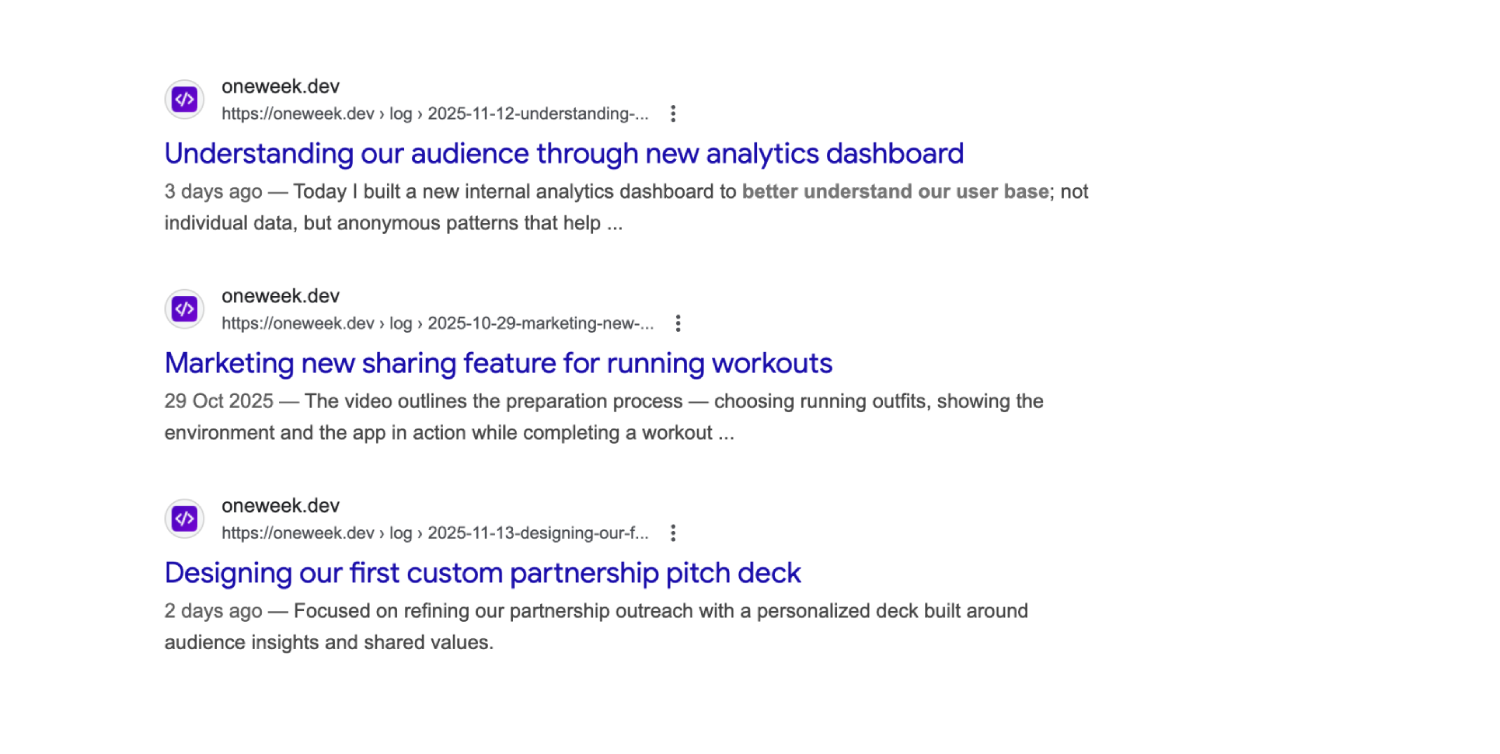
A small but satisfying improvement to make oneweek.dev more discoverable while keeping things fully manual for now and maker-friendly.